
Clarify. Create. Dominate.


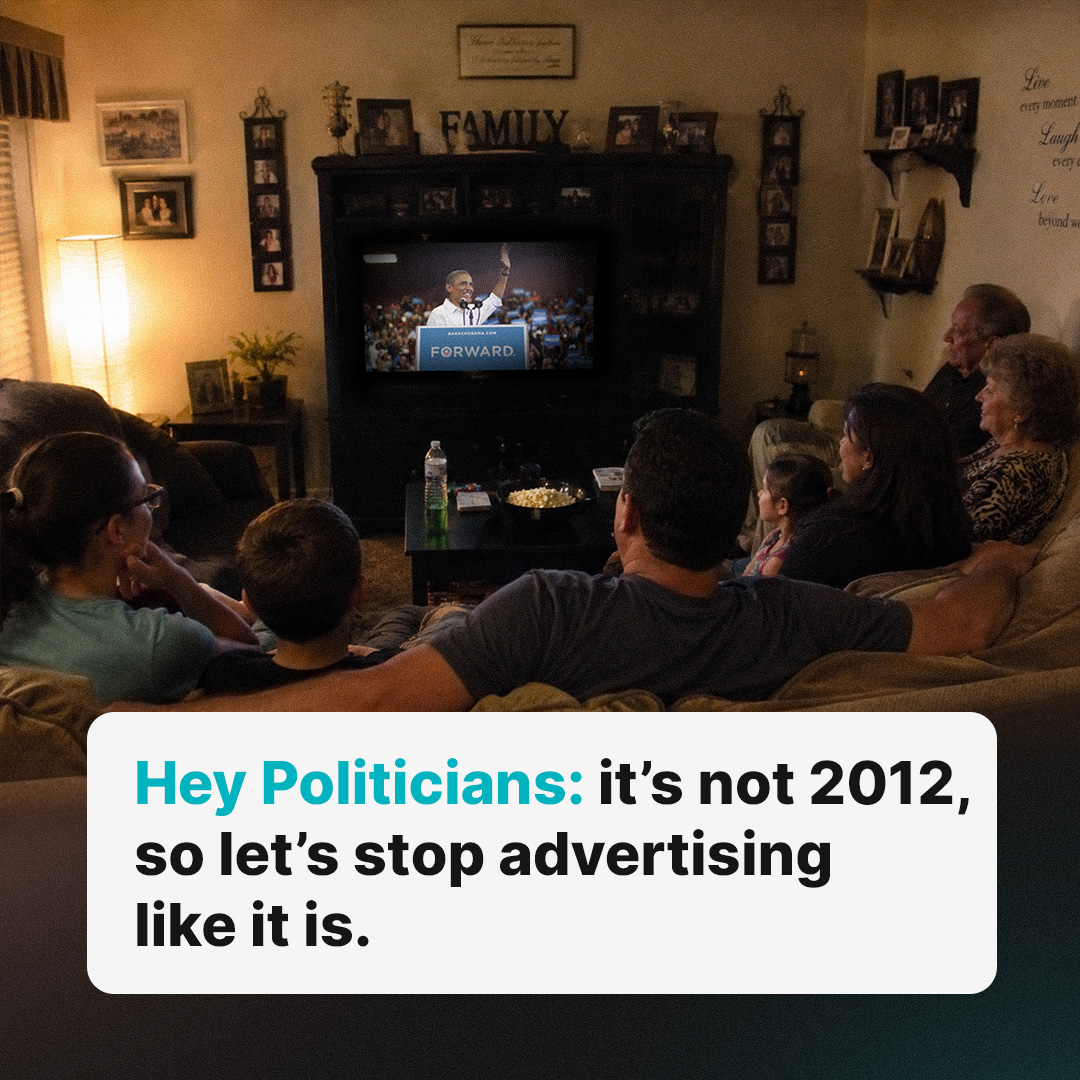
It's 2012.
You're rushing home to watch the series finale of The Office.
You turn on the radio and Call Me Maybe by Carly Rae Jepsen is playing on every station. Great, now that’s going to be stuck in your head all evening.
You’re riding high because the artsy Instagram photo of your lunch is up to a popping 12 likes. You just know it was that kickass sepia filter that really elevated the meal.
.png)
Barack Obama is running for re-election.
Donald Trump is best known for firing famous people Thursday nights on the Celebrity Apprentice.
Nobody knows what TikTok is. Heck, even Vine wasn’t going to be invented until next year.
Spencer Pratt was still cast under the shadow as the villain on The Hills.

And if you wanted to influence public opinion, you bought a television ad because we all watched live TV. Remember live TV?
Fast forward to 2026. Now fourteen years later, and every one of those things has changed.
Except political advertising.
Well, that's not entirely true.
The best campaigns today still understand the same thing they did in 2012: a compelling message is everything.
What has changed is how people consume information.
Too many campaigns are still creating content as though everyone is listening to the radio on the drive home and sitting down to watch the same show at the same time.
They're not.
Today's voters are getting information from creators, podcasts, influencers, group chats, memes, YouTube clips, and algorithm-driven feeds tailored specifically to them.
The problem isn't that campaigns haven't embraced digital media.
Most campaigns have social media accounts. They run digital ads. They post videos. They buy influencer partnerships. They have content calendars.
The problem is that they're still creating content for a media environment that no longer exists.
They take a television ad, upload it to TikTok and wonder why nobody watches.
They take a press release, turn it into a graphic and wonder why nobody shares it.
They take a screenshot of a graph from a news report and wonder why their engagement tanks.
They mistake posting content for earning attention.
In 2026, attention isn't guaranteed.
It has to be earned.
For most of modern political history, communication was relatively simple.
There were a handful of television networks. A few major newspapers. A small number of radio stations.
If you bought enough advertising or earned enough media coverage, you could reasonably expect a large percentage of the population to see your message.
-(1)%2520(1).jpeg)
Everyone was watching the same shows, reading the same headlines, and talking about the same stories.
Today, that shared media experience barely exists.
One voter spends their evening watching hockey highlights on TikTok.
Another is listening to a three-hour true crime podcast.
Someone else is getting their news from YouTube creators.
And others, like me, have gone down an 80-video rabbit hole of 2025 Blue Jays highlights.
Every voter now lives inside a completely different media ecosystem completely tailored to their personal preferences.
But, many political campaigns still behave as though they are speaking to a single audience gathered around the same television.
%2520(1)%2520(1).png)
They're not.
This is where many campaigns get it wrong. They think they're competing against the opposing party. In reality, they're competing against everything, simultaneously. Long gone are the days when viewership was sequential in blocks of time dictated by major telecoms.
You’re competing against sports highlights.
You’re competing against Netflix.
You’re competing against memes.
You’re competing against podcasts.
You’re competing against creators.
And you’re competing against internet-native politicians like Spencer Pratt.
And that last one matters more than you think.
No, Spencer Pratt didn't win the race in Los Angeles. But millions of people watched his videos and his online campaign helped transform a Republican reality TV villain into a come-from-behind contender in America's most Democratic city. In the process, he rewrote the playbook for digital campaigning.
Love him or hate him, Spencer Pratt understands how modern attention works. His content is immediate. Reactive. Personal. Entertaining. It feels native to the internet.
The White House is also having their digital moment. You can’t deny that their tweets, reels, graphics, and videos are being consumed by eyeballs who would never vote for them. Even if you hate them, let’s admit, we’re all watching their content.
Meanwhile, many political campaigns in Canada are still producing content that feels like a 2012 television commercial accidentally uploaded to TikTok.
And here’s the scary truth: every minute someone spends watching your opponent’s content is a minute they’re not spending watching yours.
That’s the difference between understanding the attention economy and wishing for an era that’s long gone.
This is where many political strategists draw the wrong conclusion.
They look at creator content and decide the answer is to be more casual.
More chaotic.
Less polished.
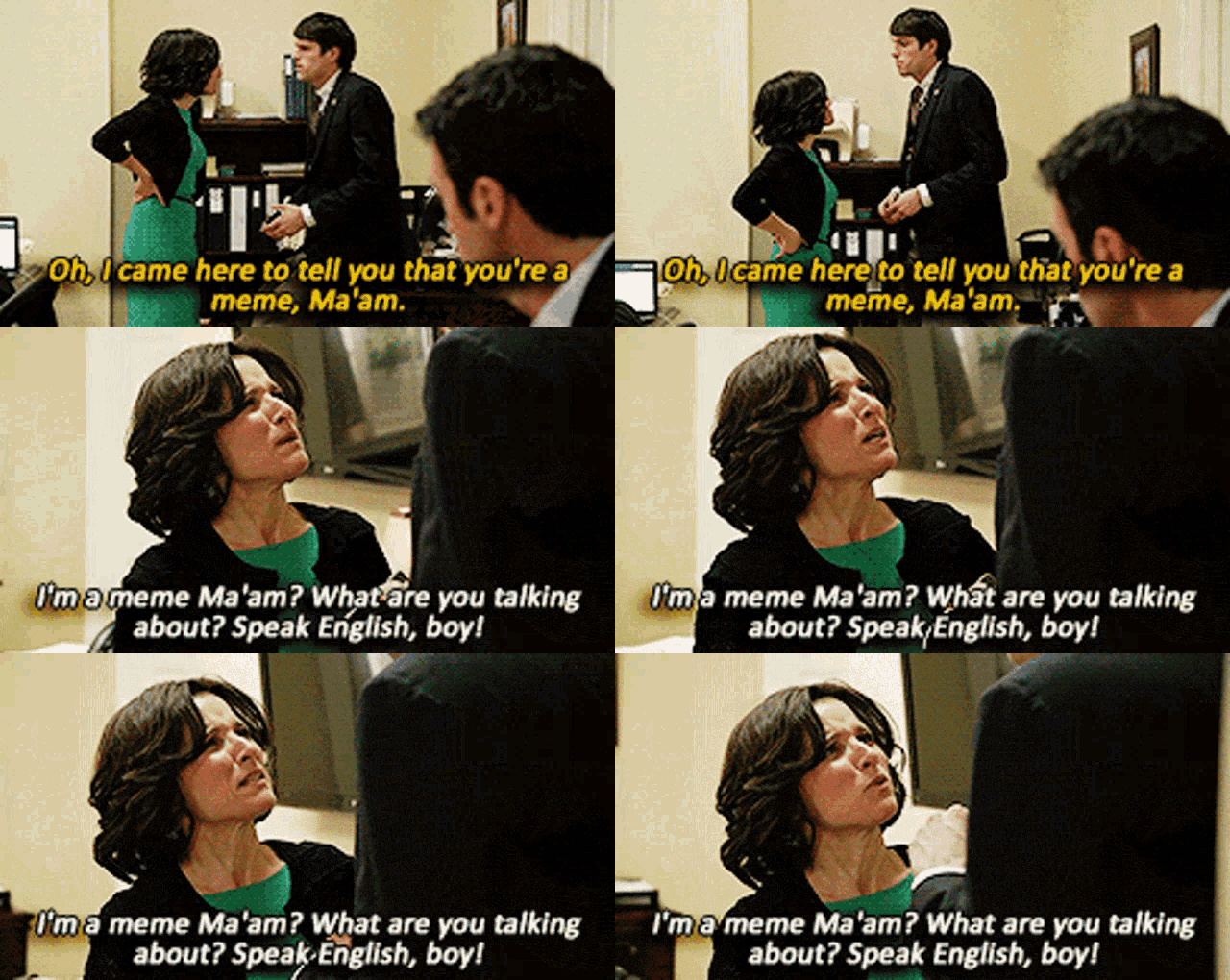
Or worse, they assume the answer is simply to generate more content, throw some siren emojis in the caption, and blast it to all platforms.
That's not the lesson.
The internet isn't rewarding low-quality content. It's rewarding content that feels human and meets the moment. There's a difference.
An iPhone selfie video with a clear point of view will outperform a million-dollar ad that says nothing.
Not because audiences hate production value.
Because audiences hate generic messaging, and they can spot fake from a mile away.
.gif)
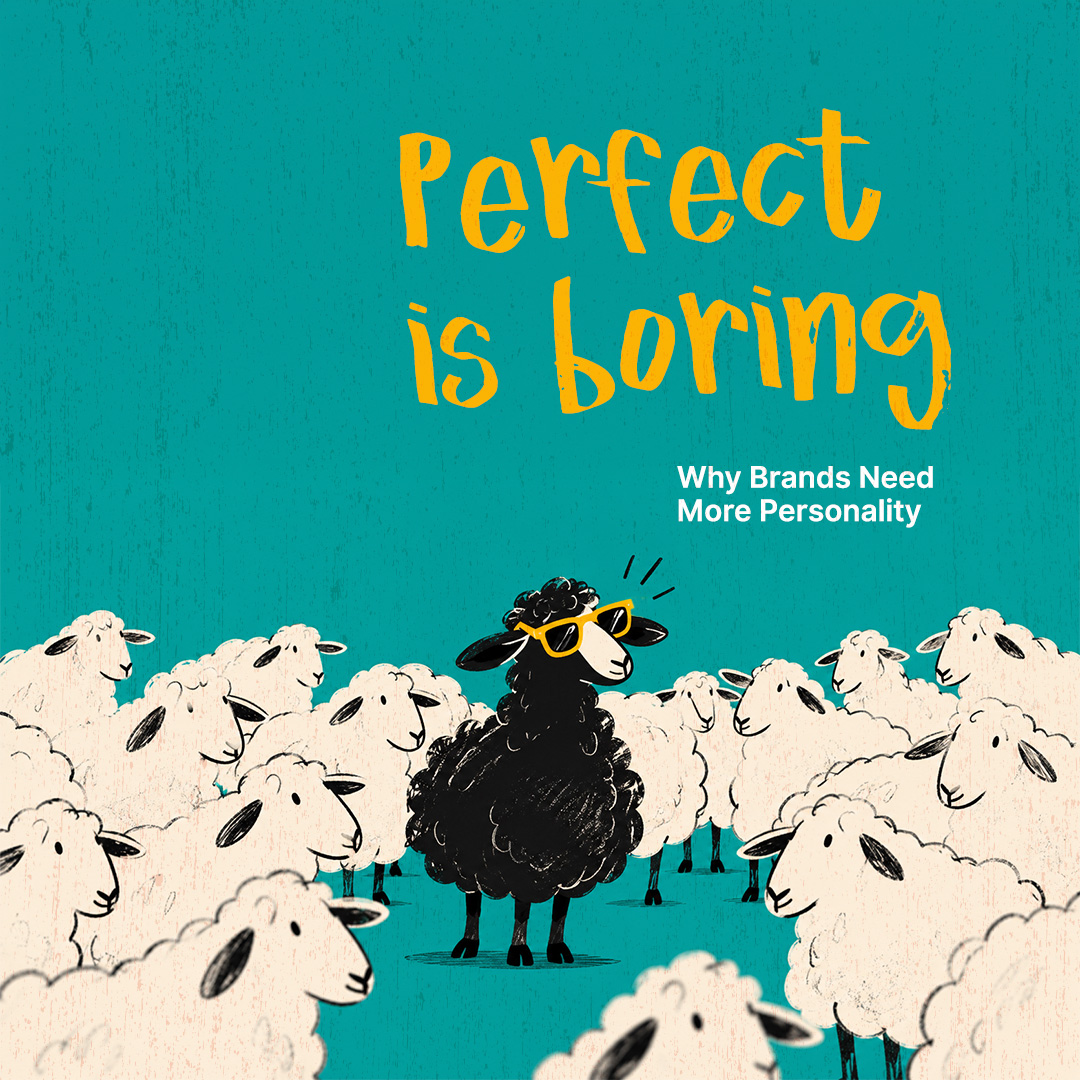
The real advantage creators have isn't their cameras. It's their authenticity. It's their personality.
It's their ability to clearly articulate a message that matters and do it in a way that matches current digital trends.
The rise of AI has made this even more important.
Campaigns can now generate graphics, videos, captions, scripts, emails, and advertisements faster than ever before.
That's useful. But it doesn't solve the core problem.
Because content isn't scarce anymore.
Attention is.
And increasingly, so is authenticity.
The campaigns that win won't be the ones producing the most content.
They'll be the ones producing the most compelling content.
The ones with the clearest story.
The strongest narrative.
Made more memorable by using tactics that disrupt and make them impossible to ignore.
AI can help scale distribution, but it can’t create a message that resonates.
Whether it's creators, influencers, or politicians like Zohran Mamdani, the people breaking through online understand one thing:
They're not creating political content.
They're creating content people actually want to consume.
And, they know they’re not just competing against other politicians; they're competing against a superhuman media ecosystem.
That's a very different mindset.
The goal isn't simply to get messages out into the ether or check a box by shelling out lame talking points with a lo-fi background track and a logo bumper at the end.
The goal is to earn attention.
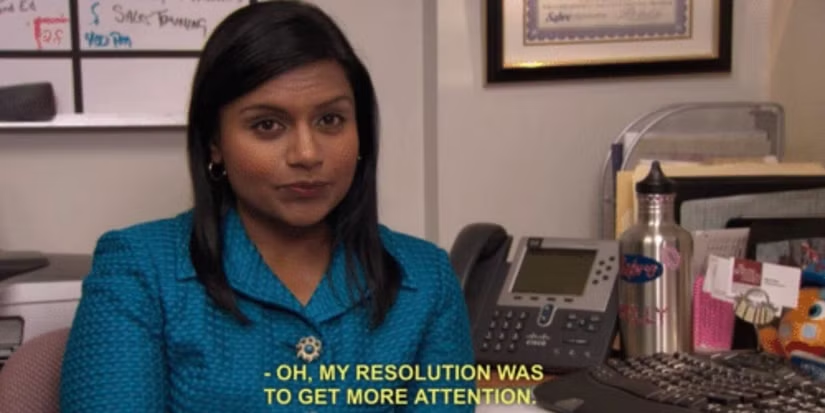
And, in a world where every voter's feed is filled with thousands of voices competing for their attention every second of every day, earning attention is everything.
And let’s be clear, no one is going to give you a free pass just because you’re a politician.
People don't rush home to watch television at a specific time anymore.
They don't consume media in neat, predictable ways.
They don't sit patiently through content simply because it was placed in front of them.
The internet changed everything.
Attention changed.
Culture changed.
Political communication needs to change too.
So, let's face reality: if your content doesn't earn attention, nobody is going to watch it.
That doesn't mean chasing every trend or turning every politician into a TikTok creator.
It means starting with a message people actually care about.
Then, finding creative ways to communicate it in the places people are already paying attention.
The campaigns winning today aren't necessarily spending the most money or producing the most content.
They're the ones with the clearest message, the most creative execution, and the strongest understanding of how modern audiences consume information.
In other words: clarify the message, create content people actually want to engage with, and dominate the conversation.
Because if your campaign still looks, sounds, and feels like it's trying to reach the 2012 voter, you're already losing the attention battle before you've even started.
And, unlike your Instagram lunch photo from 2012, 12 likes probably won't cut it anymore.


.avif)